

A. The influence of screw head shape
1. Countersunk head (flat head)
◦ Effect: After tightening, it is flush with the mounting surface, suitable for scenarios where high appearance flatness is required (such as furniture, panels), but the applied torque is slightly lower than that of the round head.
2. Round head
◦ Impact: With a protruding head, a large force application area, and more stable torque transmission, it is suitable for structural connections that do not require flatness, and has good anti-drop performance.
3. Round head/Large flat head
◦ Impact: With a large contact area, it can distribute pressure, making it suitable for thin and fragile substrates (such as plastic sheets) to prevent twisting and puncturing.
4. Hexagonal socket head
◦ Impact: High torque applied, suitable for high-strength fastening (such as mechanical assembly), and the head is hidden inside the hole, providing good theft resistance.
5. Cross/straight head
◦ Impact: It is compatible with conventional screwdrivers, with low cost and strong versatility. However, it is prone to slipping under high torque, making it suitable for low-load fastening.
GRANDFAST offers a variety of different head shapes. Please feel free to inquire.
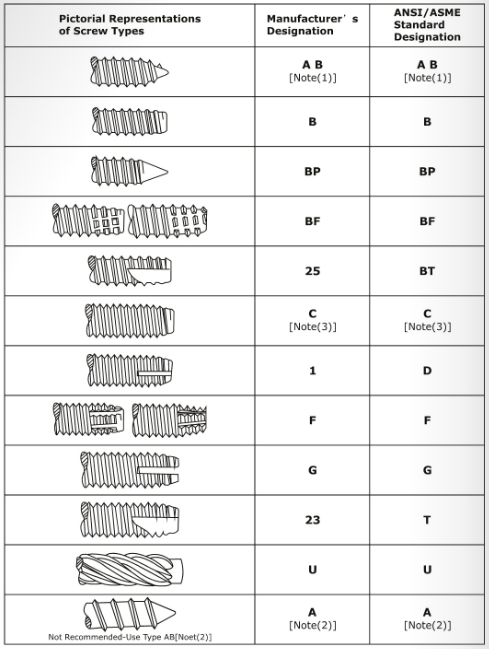
B. The thread type of a screw determines its fastening force, compatible substrate, and installation method, while the head shape determines the force application method, installation space, and fastening appearance. Both factors jointly influence the usage scenario and performance of the screw.
1. The influence of thread type
1. Ordinary machine thread
◦ Features: Uniform pitch and standard thread form.
◦ Impact: With adaptable nuts or preformed threaded holes, it provides stable fastening force and is commonly used for metal connections, facilitating easy disassembly and assembly.
2. Self-tapping threads
◦ Features: The tooth shape is relatively thick, with a drilling structure at the tip.
◦ Impact: It allows for direct tapping on plastic, wood, or thin metal without the need for pre-drilling (or with only a shallow hole required), resulting in high installation efficiency. However, repeated disassembly and assembly may cause the thread to become stripped.
3. Double-segment thread
◦ Features: It is divided into two sections: coarse thread and fine thread.
◦ Impact: One end is compatible with soft substrates (such as wood), while the other end is compatible with hard substrates (such as metal), making it suitable for connecting heterogeneous materials and reducing the risk of loosening.
4. Coarse thread
◦ Features: Large tooth spacing and wide tooth peaks.
◦ Impact: Low resistance when screwing in, suitable for soft materials such as wood and plastic, strong biting force but low fastening accuracy.
5. Spiral pattern/groove type
◦ Features: With spiral groove or axial groove.
◦ Impact: When screwing in, it can discharge debris from the substrate, reducing jamming, making it suitable for installation in dense boards or blind holes, and enhancing the smoothness of installation.
GRANDFAST offers a variety of different screw thread. Please feel free to inquire.